
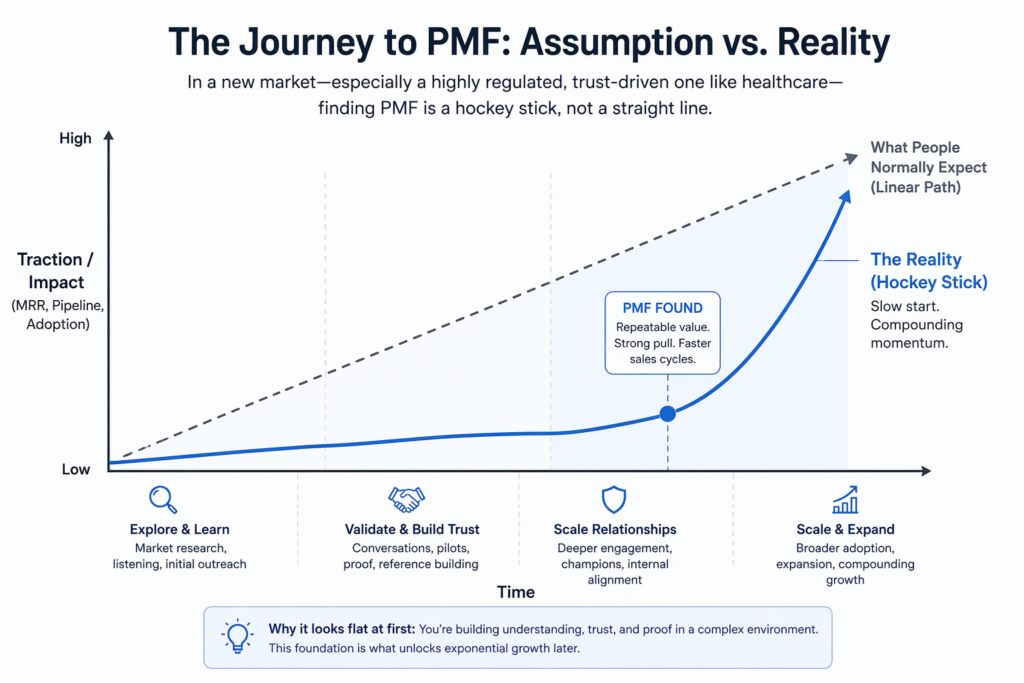
When companies set out to enter a new market, there’s an implicit expectation that growth will follow a steady, linear path.
You invest in outbound.
You generate leads.
You convert pipeline.
You scale.
Up and to the right.
That expectation shows up in forecasts, sales plans, and often in how success is measured early on.
But in reality—especially in enterprise, highly regulated, trust-driven markets like healthcare—that’s not how traction actually forms.
The Myth of Linear Growth
Most go-to-market plans assume a direct relationship between activity and outcome:
- More outreach → more conversations
- More conversations → more pipeline
- More pipeline → more revenue
This works reasonably well in:
- Established markets
- Lower ACV products
- Transactional sales cycles
But it breaks down quickly when you introduce:
- $1M+ deal sizes
- Multi-stakeholder buying committees
- Regulatory constraints
- High trust thresholds
In those environments, early activity doesn’t immediately translate into visible pipeline.
And that’s where most teams start to question whether things are working.
The Reality: A “Hockey Stick” Curve
Finding product-market fit in a new market doesn’t look like a straight line.
It looks like a hockey stick.
There’s an initial period where:
- Conversations increase
- Market understanding deepens
- Messaging sharpens
- Relationships form
But visible outcomes (pipeline, revenue) lag behind.
From the outside, this phase can look flat.
Internally, it’s anything but.
What’s Actually Happening in the “Flat” Phase
That early phase is where the most important work happens:
1. Market Understanding Is Being Built
You’re learning:
- Who actually feels the problem
- How they describe it
- What triggers action vs. indifference
This can’t be shortcut.
2. Trust Is Being Established
In markets like healthcare, people don’t engage with vendors—they engage with trusted partners.
Trust is built through:
- Repeated exposure
- Credible conversations
- Peer validation
- Proof over time
This takes cycles, not campaigns.
3. The Right Entry Point Is Discovered
What you think is the buyer at the start is often not the buyer that converts.
Early traction work reveals:
- The real economic buyer
- The internal champions
- The fastest path to adoption
This is often the difference between:
- Burning budget on the wrong audience
- Unlocking a scalable channel
4. Signal Is Separated From Noise
Not all engagement is equal.
The goal early on is not volume—it’s signal:
- Who leans in
- Who responds with intent
- Who is worth pursuing further
That signal becomes the foundation of pipeline.
When Product-Market Fit Clicks
At some point, something changes.
- Conversations get easier
- Messaging lands faster
- Sales cycles shorten
- Internal alignment on the buyer side improves
What felt slow suddenly accelerates.
This is the inflection point—when product-market fit begins to emerge.
And when it does, growth stops being linear and starts compounding.
Why This Matters for Early Metrics
If you measure early traction using only end-state metrics (pipeline, revenue, win rate), you’ll miss what’s actually happening.
Those metrics are outputs of product-market fit, not indicators of whether you’re finding it.
Early on, the more accurate indicators are:
- Quality of conversations
- Engagement rates vs. benchmarks
- Speed of learning and iteration
- Emergence of repeatable patterns
These are the signals that precede scale.
The Takeaway
If early traction feels slower than expected, it doesn’t necessarily mean something is wrong.
In many cases, it means you’re doing the right work—just before it becomes visible.
Especially in:
- New markets
- High ACV enterprise sales
- Regulated, trust-driven environments
The path to growth isn’t linear.
It’s a hockey stick.
And everything that feels “flat” at the beginning is what makes the curve possible later.
Final Thought
The companies that succeed in these environments aren’t the ones that try to force early linear growth.
They’re the ones that:
- Stay disciplined in the learning phase
- Focus on signal over volume
- Build trust before scaling
Because once product-market fit clicks, growth doesn’t need to be forced. It starts to pull.